(None of these links are affiliate).
(TL;DR: google “graphismes MS/GS” first, teach boucles on a slate or whiteboard, print large cursive letters that the child can trace with their fingers, print the writing booklet from Bout de gomme. Buy a notebook with lignes seyès in it.)
Teaching cursive right from kindergarten is a new adventure for me, and this blog post is about how I have been doing it.
I’ve said before that I am not a fan of early academics, but J, my four year old, loves to sit down and do “work”. He really enjoys writing letters. So I made a booklet for him using a duotang and pages I printed from Bout de gomme. I wanted something he could just grab whenever he wanted, when I am too busy to work with him or to make photocopies for him.
Don’t feel bad if your 4 year old doesn’t show any interest in school yet. None of my other kids were ever this precocious!


(He flew through this book and was done before I even published this post haha).
When I first started homeschooling, for some reason I thought that teaching cursive seemed like a very difficult and monumental task. I don’t know why I thought that, but I must not be alone, because my friends with children in public schools tell me that the schools no longer teach cursive, and even homeschoolers who do teach cursive often wait a few years into schooling to start. Is it so hard to teach that even the schools have given up on it?
In any case, I wanted to teach cursive because I am old fashioned, but also because it is important for reading many things. If you want to read any handwritten historical documents, you need to know cursive! And there are a lot of French children’s books in cursive. Anatole Latuile is in cursive!
As I started dabbling in French immersion homeschooling, I noticed many of the resources from France included activities in cursive, even starting from kindergarten. Also, I was getting very frustrated with how messy my children’s writing was. So I asked my friend who lives in France if it is true that in France kids start learning cursive right at the start. She said it is, and that she started learning when she was five. That’s when she told me about graphisme! French kindergarteners spend a lot of time practicing their loops and swirls and fine motor skills before they start forming actual letters. If you Google “graphisme GS” or “graphisme MS” you will find a lot of things. Bout de gomme also has a graphisme booklet you can print for free.


And then, I have these books from La Librairie des écoles which have them trace lines and curves and so forth:


Colouring is also important. Basically anything that aids in fine motor skills is useful. The books from La libraire des écoles have teeny tiny little boucles, and so may prove to be too difficult. I also learned afterwards that light blue lignes seyès don’t photocopy well. I might go see how much it would cost to photocopy these in colour at Staples. It’s surely cheaper than having them shipped from France for each child!
These books I have from Bordas are a bit more realistic in terms of letter size:


One thing I really like about the MS book is that it gets kids to trace the graphismes with their fingers first. That is also very important.

And then there are these two wonderful videos from Kiffer l’école, made by an elementary teacher, that explain very well how to teach the boucles. Video 1 and Video 2. I made my own boucles sheet to hang up on our bulletin board so that I can remember all the steps.

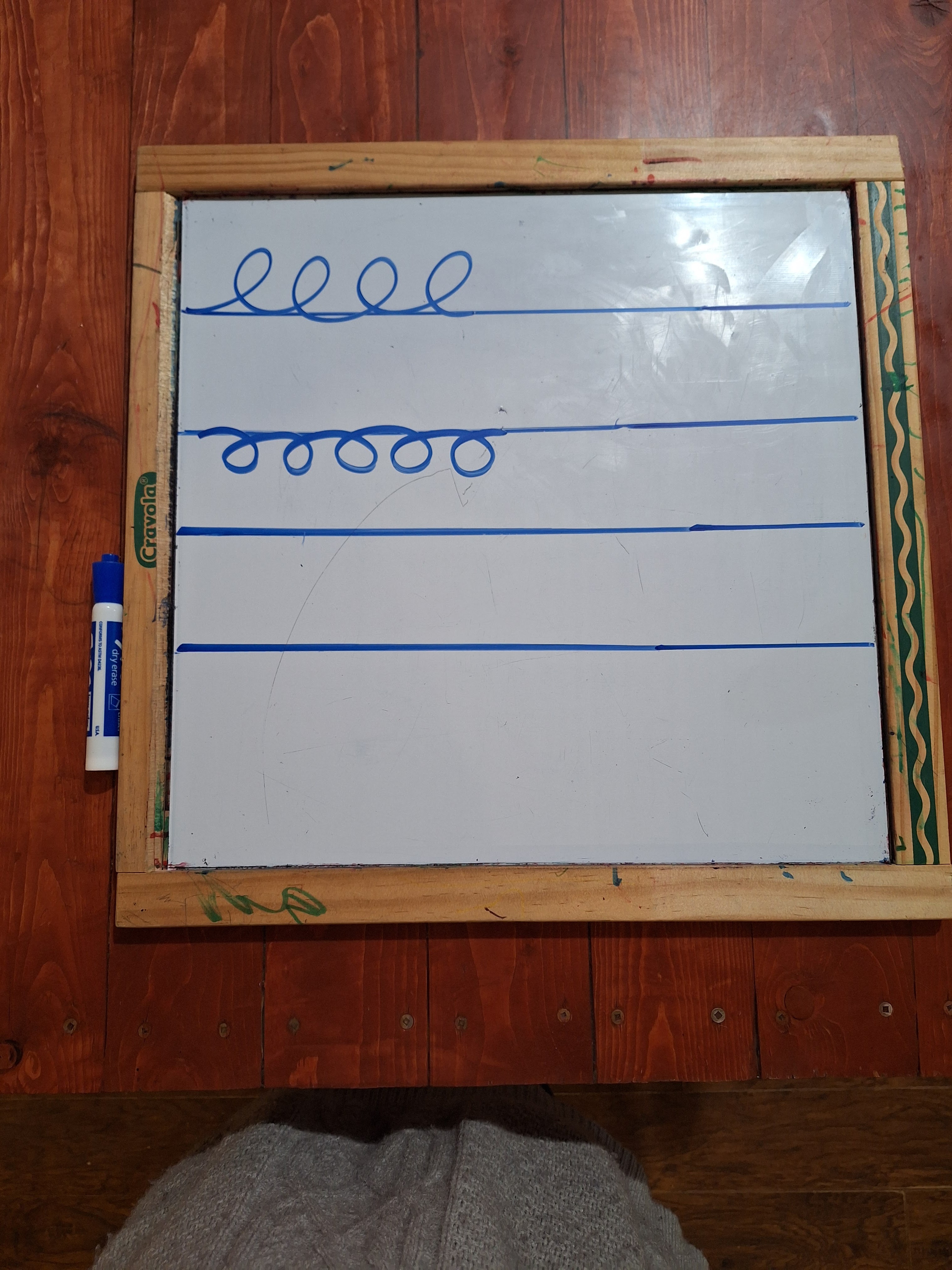
I have a rather large portable whiteboard, about 1.5’ by 1.5’ (don’t ask me to convert that to cm). It actually came from a child’s easel that fell apart, so if your child easel falls apart, keep the whiteboard and chalkboard parts! Anyways, using a ruler I trace straight lines on it, and then give my 4 or 5 year old some boucles to copy. They love it because it is not every day I let them use the whiteboard markers! I also have a chalkboard and sometimes have them work on that, too. Here’s the idea:

Sometimes I forget that kids actually need to know the alphabet before we dive into writing. There are two videos I use to help teach the alphabet in French: the spoken one here, and the song one here. We have watched the Simon le Lapin one so many times that my kids can quote from it. My 7 year old decided she was going to teach my 4 and 5 year old the French alphabet one day, and she drew on a chalkboard and spoke exactly the same way that Simon le Lapin does. I was pretty impressed.
And so we learn the alphabet, and we do graphsimes and boucles. I also like to give them pages that have them spot the letter, like coloriages magiques and circling the letter when it is mixed with other ones. Bout de gomme and ma maternelle have some good ones, and I like the coloriages magiques from apprendre à lire.
Bout de gomme has large, page-sized cursive letters that are good for finger tracing.
You will also need notebooks with the lignes seyès, which are the lines that French people write on. They are so much more logical than American paper, because they allow for a more precise writing. I looked a long time for some seyès notebooks you could get in Canada. Unfortunately I didn’t find anything quite as good as what you can buy in France, but the closest thing I found was this:


These lignes are 3mm, so slightly larger than the regular ones. I like that this notebook has the three different colours for the lines, just like a real Clairefontaine. It was the only one like it on Amazon Canada that I could find. It also shows the proper size for each letter in the front of the book, which is very useful! Both my fourth and fifth grader have shown improvement in their writing since using the lignes seyès, but when they use regular American paper their writing tends to revert to being rather sloppy. It also can depend on how they feel on any given day and whether they want to make the effort or not.
My 4 and 5 year old have not been using this notebook. I bought it for the older kids. In the Kiffer l’école videos that I linked to above, her cahier de CP appears to have bigger carreaux than the 3mm kind. I tried to find it online to no avail. But I did find a website called Générateur de feuilles that makes custom pages for you. Fooling around with the settings a bit, I managed to make this:

Well, I don’t know yet what paper I will use once my little ones have advanced to writing in notebooks. I will write an update on that when the time comes! This is, after all, a new experiment for me. Let me know if you know of a French CP workbook available somewhere.
As I mentioned above, the light blue lignes seyès don’t photocopy, and I don’t really want my children writing in books that shipped here from France! So while they are still learning, I think Bout de gomme and other websites where you can print the pages are best. The Bout de gomme pages print beautifully, especially if you print regular and not in toner-save mode. My older children copy from the French workbooks into a seyès workbook.
This is not related to MS/GS/kindergarten, but this book is what my grade fiver is using for French copywork:

She copies it into her lignes seyès cahier. I love this book because it has entire paragraphs for her to copy, not just individual words, as most workbooks seem to have.

Last year I printed off copywork from traditional fairy tales here.

Leave a Reply